
-
Response of Greater Sage‐grouse to Sagebrush Reduction Treatments in Wyoming Big Sagebrush
An experimental study conducted in Wyoming examines how sage-grouse responds to sagebrush reduction treatments.
-
Future-proofing the outdoor recreation economy

Explores how outdoor recreation communities can enhance resilience to natural disasters like wildfires and floods while securing the future of their economies
-
Fire-Resistant Landscaping

Fact Sheet 6.303 | Wildfire Mitigation Series, Landscaping and Planting
-
Fire Networks (FLN-TREX-FAC Net-IPBM)

FULL ARTICLE HERE The Fire Networks partnership invests in people and place-based efforts to change relationships with fire, helping foster shared responsibility for fire management and viable fire cultures in landscapes and communities across the country. We work through three interconnected peer networks—the Fire Learning Network (FLN), Fire Adapted Communities Learning Network (FAC Net) and…
-
Wilderness and Fire

Barriers and Opportunities for Wilderness Fire in a Time of Change
-
PRESCRIBED FIRE AND U.S. WILDERNESS AREAS

Barriers and Opportunities for Wilderness Fire Management in a Time of Change
-
WILDLAND FIREFIGHTER FOUNDATION MENTAL HEALTH PROGRAM
The Wildland Firefighter Foundation is pleased to announce the launch of a new Mental Health program specifically designed for members of the Wildland Firefighter community.
-
National Interagency Wildland Fire Critical Incident Stress Management Website
All links are available on the National Interagency Wildland Fire and Aviation Critical Incident Stress Management website
-
Wildland Firefighter Health Series: Current Knowledge for Body, Mind, and Well-being
During this 3-day series of presentations and panel discussions, professionals and agency leaders shared some of the current science, knowledge, and tools available to support wildland firefighter physical and mental health. The series aimed to bring the latest science to those working in fire management and/or wildland firefighting. All links are available on the www.nrfirescience.org…
-
Looking to the Past to Plan for Future Wildlife Response
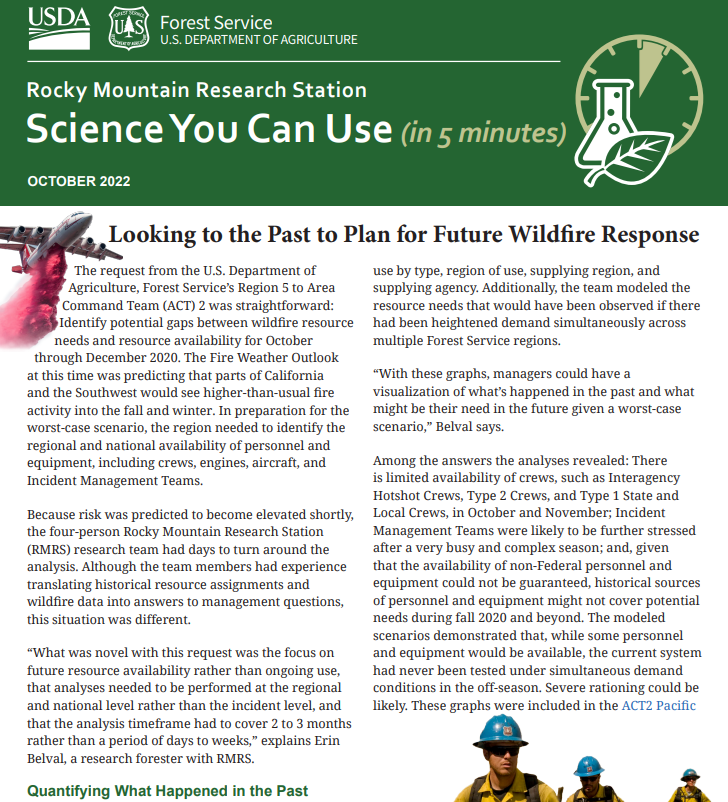
FULL ARTICLE HERE Characterizing where personnel and equipment are coming from, both geographically and by managing agency, may help fire managers project how to fill future resource needs.
Categories
- Article/Book/Chapter
- Course/Curriculum
- Education & Training
- Highlights
- Maps, Models, and Apps
- Newsletter/Digest
- Pre and Post Emergency Resources
- Publication
- Research Brief/Synthesis
- Technical Report
- Uncategorized
- Video
- Video & Audio Resources
- Webinar
- Website
Archive
- August 2026
- July 2026
- May 2026
- April 2026
- March 2026
- February 2026
- January 2026
- December 2025
- November 2025
- October 2025
- September 2025
- August 2025
- July 2025
- May 2025
- April 2025
- March 2025
- February 2025
- January 2025
- November 2023
- October 2023
- September 2023
- May 2023
- April 2022
- March 2022
- February 2022
- January 2022
- October 2021
- August 2021
- July 2021
- May 2021
- March 2021
- February 2021
- January 2021
- December 2020
- November 2020
- October 2020
- September 2020
- August 2020
- July 2020
- June 2020
- May 2020
- April 2020
- March 2020
- July 2019
- July 2018
- June 2018
- October 2017
- September 2017
- June 2017
- April 2017
- March 2017
- November 2016
- October 2016
- August 2016
- May 2016
- April 2016
- November 2015
- October 2015
- September 2015
- June 2015