• Skip to primary navigation
  • Skip to main content
Southern Rockies Fire Science Network

Southern Rockies Fire Science Network

JFSP Fire Science Exchange Network

  • Home
  • About Us
    • About Us
    • Our Partners
  • Subregions
    • Why Subregions?
    • Black Hills / Pine Ridge
    • Canyonlands/Desert Montane
    • Northern New Mexico Plateau
    • Southern Rockies
    • Wasatch Plateaus/Uinta Mountains
    • Wyoming Sagebrush
  • Events
    • Event Summaries
  • Resources
    • Pre and Post-Fire Emergency Resources
    • Research & Publications
    • Maps, Models & Apps
    • COVID-19
  • Contact
  • Show Search
Hide Search

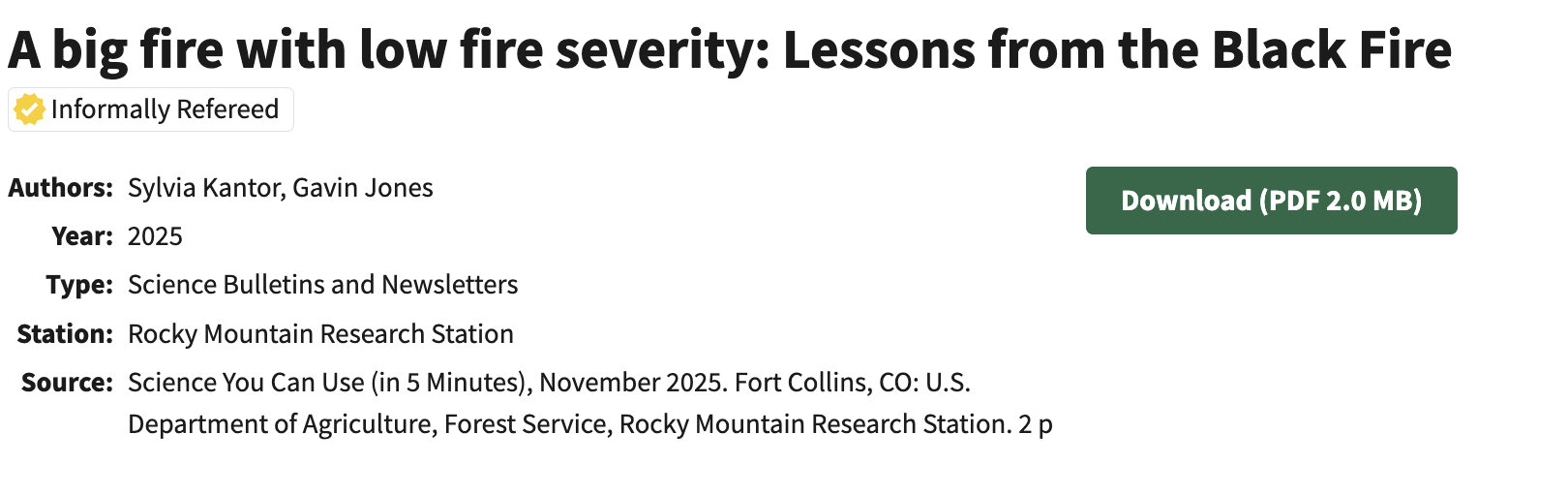
A big fire with low fire severity: Lessons from the Black Fire

“When the Black Fire ignited in southwestern New Mexico in 2022, it had all the ingredients for disaster: record-high winds, extremely low humidity, and over 131,000 hectares (323,708 acres) of forest fuels to feed on. But something unexpected happened. Instead of becoming another catastrophic megafire, it burned mostly at low to moderate severity. The secret? The landscape had already experienced dozens of previous fires, both planned and natural, that helped tame the beast.”

Read HERE

Posted by:
Angela Hollingsworth
Published on:
March 16, 2026

Categories: PublicationTags: Fuels reduction, lower burn severity, wildfire

Footer

Connect With Us

  • Facebook
  • Twitter
  • YouTube

Sign up for our newsletter

Got a Question?
Email us.

This regional Fire Exchange is one of 15 regional fire science exchanges sponsored by the Joint Fire Science Program (JFSP).
View resources from multiple exchanges.