
- This event has passed.
2024 Aspen Summit: Smart Management & Culturally-Sustaining Co-Stewardship of Quaking Aspen
Summary of Event and Photos
 Workshop participants discuss differences in aspen genetics
Purpose
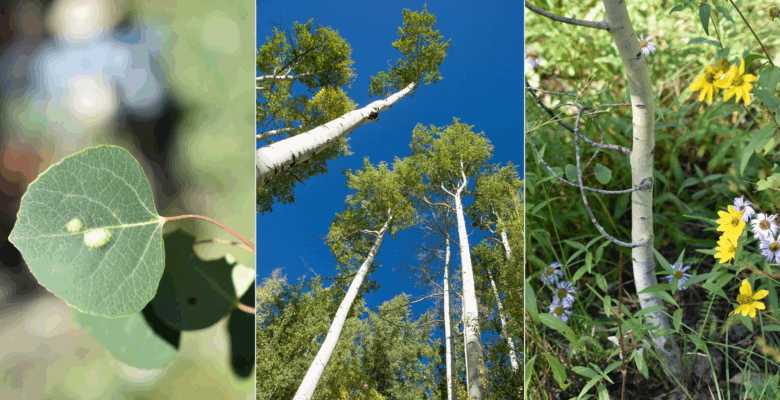
From the mountains of Mexico to the coasts of Newfoundland and the forests of Alaska, quaking aspen (Populus tremuloides) can be found across the North American continent. Its broad range makes aspen a cornerstone of North American forests, providing shelter and food for wildlife, supporting local communities, and carrying deep cultural meaning for many people. However, these forests are changing. Shifting fire regimes, land use pressure, and other disturbances are reshaping aspen ecosystems, prompting an urgent need for renewed scientific, cultural, and management attention. As such, a wide range of stakeholders are seeking to understand the impact of these changes and take effective, ethical action in response, including:
- Scientists
- Federal and state land managers
- Tribal Nations
- Private landowners
- Non-governmental organizations
Shifting Approaches in Stewardship
The Southern Rockies Fire Science and its partners have hosted regular aspen-centered workshops over the years, with a focus primarily on top-down management and knowledge transfer. While useful, this approach rarely pulled in the broader mix of voices needed at the table. Today, many recognize that lasting stewardship means looking beyond the dominant government and academic umbrellas, and bringing in the perspectives of many different communities. Yet barriers to co-stewardship remain, including:
- Information gaps– Limited awareness of current science, best practices, and management tools
- Disconnected networks– Few opportunities for cross-boundary exchange, learning, or relationship-building
- Trust barriers– Historical inequities and differing worldviews have made collaboration difficult, particularly between Indigenous and non-Indigenous partners
To begin working toward strategic, culturally sustaining co-stewardship of aspen forests, the 2024 Colorado Annual Summit aimed to unite people from multiple backgrounds into a space that prioritized:
- Listening across differences
- Building trust, relationships, and collaborations
- Exchanging knowledge and best practices around quaking aspen forests
- Developing conceptual understandings of co-stewardship principles and practices
- Centering Indigenous voices and perspectives
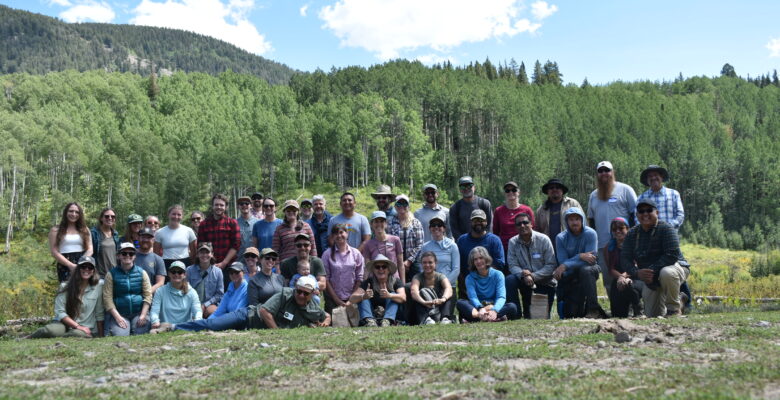 2024 Aspen Summit workshop participants
Organizers & Attendees
The summit was organized by a diverse planning committee representing academic institutions, Indigenous-led organizations, and fire science networks. Members included:
- Benjamin Wong Blonder, University of California, Berkeley
- Roxy Cruz, University of California, Berkeley
- James Calabaza and Mike Martinez, Trees, Water & People
- Jonathan Coop, Western Colorado University
- Gloria Edwards, Southern Rockies Fire Science Network and Colorado State University
- Paul Rogers, Utah State University, Western Aspen Alliance
The primary audience for the workshop included individuals engaged in aspen ecology and forest management, particularly those with decision-making or communication responsibilities. A total of 53 attendees participated, representing a broad geographic and professional range. Individuals from the United States, Canada, and Mexico attended, representing academic institutions, government agencies, Tribal Nations, and the private sector. Notably, the workshop welcomed representatives from five federally recognized Tribal Nations and one Canadian First Nation:
- Leech Lake Band of Ojibwe
- Pueblo of Jemez
- Ute Mountain Ute
- Jicarilla Apache
- Turtle Mountain Band of Chippewa Indians
- Samson Cree, Canadian First Nation
 Regina Lopez Whiteskunk, Ute Mountain Ute member, addresses workshop participants in opening ceremony
Workshop Summary
The aspen summit took place over two days and three nights, beginning the evening of August 27, 2024, at the Rocky Mountain Biological Laboratory in Gothic, Colorado, within the Gunnison National Forest. Now home solely to the field station, Gothic features historic cabins, meeting spaces, and a shared dining hall. Once a silver and lead mining town established by white settlers, Gothic sits within the ancestral homeland of the Ute people, whose deep connection to the land continues despite their forced removal in the 19th century (Haase 1971; Jones 2019). This enduring relationship set the tone for the gathering, opening with an Indigenous-led ceremony and recognition of place.
Grounded in this setting, the summit gathered participants around two guiding themes:
- Sustaining relationships between forests and people
- Promoting forest resilience in a time of rapid environmental change
The program unfolded through a blend of shared readings and virtual conversations that began before arrival, then deepened on-site through discussion panels and field sessions. Indigenous-led opening and closing ceremonies framed the event, reminding participants that this was not just a workshop about managing aspen but a part of a larger, living story of stewardship.
Opening Ceremony
The gathering began with a prayer offered by Regina Lopez Whiteskunk of the Ute Mountain Ute Tribe and the Cross-Cultural Programs Director with the Montezuma Land Conservatory, grounding participants in the cultural and historical significance of the land beneath their feet. Building on that foundation, organizers outlined the workshop’s goals: to strengthen trust and collaboration, to exchange knowledge and experiences about Colorado’s aspen ecology and the challenges it faces, and to ensure Indigenous voices and perspectives were at the center of the conversation.
 Workshop was held at the Rocky Mountain Biological Laboratory in Gothic, Colorado, Regina Lopez Whiteskunk opens workshop with ceremonial prayer
Theme I: Sustaining Relationships Between Forests and People
Co-Stewardship for Biodiversity Panel
The purpose of this panel was to develop a deeper understanding on the meaning of co-stewardship for biodiversity and how to incorporate co-stewardship into management practice. Panelists in the discussion included:
- James Calabaza, Trees Water and People (moderator)
- Camille Stevens-Rumann, fire ecologist at Colorado State University
- Kristin Waring, silviculturist at Northern Arizona University (Flagstaff)
- Garret Altman, Santa Clara Pueblo, western restoration program manager at the Environmental Policy Innovation Center.
- Serra Hoagland, national program lead at Tribal Research within the U.S. Forest Service
- Keara Lightning, Samson Cree Nation, wildfire analytics at University of Alberta
Two key questions were discussed:
- Can you identify any cases where you have seen co-stewardship approaches be successful, and if not, why not?
- How do you think co-stewardship methodologies can support aspen? How can research inform co-stewardship methodologies?
The resulting discussion highlighted both the promise and complexity of implementing collaborative, culturally grounded forest stewardship. Hopeful examples of co-management that were offered included projects that involved restoring habitats after fire, connecting forest patches for wildlife, and renewing ecosystems through tree canopy recovery. Additionally, a central theme was the need to reconceptualize biodiversity to include humans as part of the ecosystem, particularly through Indigenous knowledge (IK) that recognize longstanding relationships with the land. Panelists emphasized that successful co-stewardship must move beyond bureaucratic frameworks and crisis-response models, which often exclude Indigenous voices and perspectives. Co-stewardship must instead be local, adaptive, and rooted in sovereignty, history, and relationships, acknowledging that there is no one-size-fits-all approach. Across the conversation, speakers underscored the need to:
- Begin meaningful engagement early in the process to develop more comprehensive and co-developed research questions
- Invest in long-term relationships, workforce development, and local capacity—especially in Tribal communities
- Support Tribally led stewardship efforts and enterprises (e.g., nurseries)
- Address key challenges: limited funding, high staff turnover in agencies, and institutional barriers to equitable collaboration
 James Calabaza, Indigenous Lands Program Manager of Trees, Water, People leads participants in final reflections and next steps
Our Definitions of Co-Stewardship
On the final night of the summit, attendees split into small groups to collectively define co-stewardship. The wide range of responses revealed the complexity of this seemingly straightforward term and underscored the need for a shared vision among stakeholders:

Theme II: Promoting Forest Resilience in an Age of Rapid Fire Regime Shifts
Fire for Aspen, Aspen for Fire panel
The Aspen and Fire panel explored interactions between fire and aspen, focusing on its strong ability to regenerate after fire. Panelists in the discussion included:
- Colin Bonner, University of Waterloo
- Ellen Whitman, Canadian Forest Service
- Larissa Yocum, Utah State University
- Sarah Hart, Colorado State University
- Matt Harris, Western Colorado University
Two key questions were discussed:
- How can aspen stands be sustained or expanded to reduce wildfire risk and boost forest resilience?
- How might changing fire regimes affect aspen presence, and what role can prescribed fire or other interventions play in supporting it?
The panel explored aspen’s complex role in fire ecology, noting that while aspen can recover well after fire, its resilience is increasingly threatened by drought, insects, and disease. Researchers challenged the idea that aspen reliably acts as a natural fuel break, pointing to new evidence that it can still burn severely under extreme fire conditions. Additionally, fire suppression may appear more successful in aspen areas, but this likely reflects wetter site conditions rather than aspen’s inherent fire resistance. As confier forests shift to aspen under changing fire regimes, panelists emphasized the need for region-specific, data-driven strategies.
A critical moment arose in the discussion when the absence of Indigenous voices on the all-white panel of scientists was called out, highlighting the ongoing marginalization of Indigenous perspectives and likening such erasure to “genocide all over again.” This underscored a persistent disconnect between Western scientific frameworks and co-stewardship principles, revealing the emotional and relational toll for those advocating for truly integrated, equitable dialogue.
 Workshop participants discuss impacts of wildlife severity on regeneration in the 2023 Lowline burn and relevance of wood products with aspen
Aspen Genetics to Inform Ecology and Management
A panel discussion was held to highlight current research and opportunities in aspen genetics, and their relevance for stewarding forest lands. Panelists included:
- Barbara Thomas, University of Alberta
- Luke Tembrock, Colorado State University
- Melanie Zacharias, Laval University
- Carlyn Perovich, U.S. Forest Service
In this discussion, participants emphasized the importance of using genetic data in forest management, especially those traits trees need to survive under different environmental conditions. One key topic was genetic offset, the growing gap between current genetic traits and future environmental conditions, and how what counts as adaptive or maladaptive traits is decided. The panel raised critical questions about who controls genetic data and who benefits from it, calling for more comprehensive approaches that respect Indigenous knowledge. They noted that efforts often run on separate tracks – Western science and Indigenous stewardship – with “box-checking” approaches falling short of true collaboration. Despite institutional and time-related barriers, panelists urged that it’s not too late to shift course, even mid-project, and stressed the value of humility, uncertainty, and relationship-building.
 Workshop participants gather for poster session discussion
Field Trips
Field Trip 1
A guided field trip led by Jonathan Coop visited the 2023 Lowline Burn, a roughly 2,000-acre fire in the Ohio Creek drainage. The site illustrated the incredible capacity of aspen to resprout after a high-intensity fire and highlighted spots where aspen stands acted like “speed bumps,” slowing the fire’s spread and helping to contain its perimeter.
.
 Workshop participants witnessed different levels of burn severity in aspen stands in the 2023 Lowline burn
Field Trip 2
Two guided walks near Gothic explored local aspen stands along the Copper Creek Trail, offering hands-on learning around several key themes. The first component focused on genetics and was led by Benjamin Blonder. Participants compared trees with known genetic traits, such as sex and ploidy levels, and discussed how remote sensing predictions aligned with what they observed in the field. The group also learned how to identify common aspen diseases caused by fungi and insects, with guidance from Forest Health Protection staff. Along the way, conversations delved into the area’s complex history, including settler-driven disturbances like mining, logging, and fire, as well as Indigenous relationships with the land. These discussions sparked thoughtful and sometimes intense dialogue, deepening the workshop’s broader focus on co-stewardship.
 Workshop participants interact with aspen stands along the Copper Creek trail
Closing Ceremony
The summit concluded with an Indigenous-led closing ceremony that invited each participant to reflect on their personal journey and collective responsibility. Holding aspen branches, attendees shared prayers, insights, and intentions for how they would carry forward the lessons of co-stewardship in their own work, before throwing the branches into a fire, “watching the aspen – and our words – return to the earth” (Calabaza 2025). The act underscored not only the growth sparked by the summit, but also the deeper meaning of aspen itself: a species defined by its unseen network of roots, symbolizing the significance of building a network of relationships to co-steward this key species that represents the ultimate socio-ecological network it sustains.
 Workshop participants gather around the fire pit for a closing ceremony blessing led by tribal members at Rocky Mountain Biologic Laboratory in Gothic, CO
Resources
Recommended Readings
Recommended readings were provided prior to the workshop to help orient attendees across five key topics that dove into the themes that was addressed during the workshop:
Presentations
- Presentations pending, please check back
References
- Wolf, elk, and aspen food web relationships: Context and complexity
- Patterns and consequences of ungulate herbivory on aspen in western North America
- Herbivory strains resilience in drought-prone aspen landscapes of the western United States
 Structure burn within a wildfire burn scar indicating fire severity
Key Take Aways & Next Steps
Participants throughout the summit emphasized that quaking aspen is more than a tree, it is a focal point for navigating the profound ecological, cultural, and political shifts shaping today’s forests. The summit reflected a shared urgency around changing landscapes, fire, and biodiversity loss, while also highlighting the need to rebuild trust through co-stewardship grounded in reciprocity, respect, and local knowledge.
While the workshop aimed to bring together Western science and Indigenous perspectives, it also revealed deep tensions surrounding such a dialogue. Tribal and non-tribal participants often approached issues differently, with historical harm, mistrust, and unequal power dynamics surfacing early. Many stressed that Tribal Nations must be involved from the start, not as stakeholders, but as sovereign partners with deep-rooted knowledge and living traditions.
Participants called for co-stewardship to move beyond technical fixes. True collaboration must recognize Indigenous sovereignty, confront structural and jurisdictional barriers, and make space for honest, sometimes difficult, conversations. Moving forward will require long-term commitment, humility, and a willingness to shift the status quo that prioritizes:
- Relationship-building
- Shared decision-making
- Process-based restoration tailored to local needs and the cultural significance of landscapes to the people who call them home
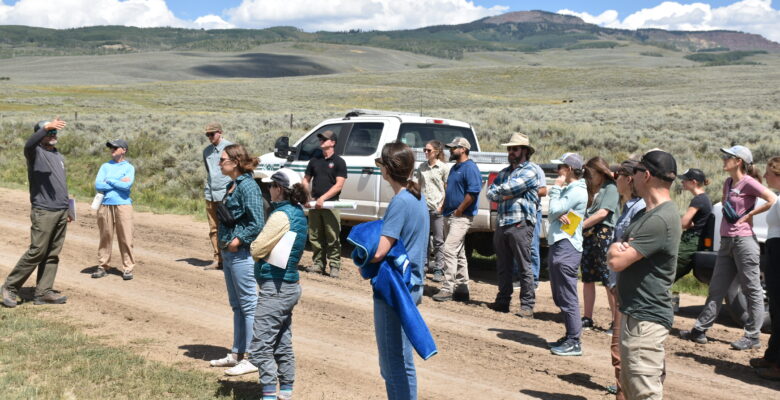 Workshop participants view wildfire burn scar to the West
Parallel Research – Tribal co-stewardship in practice: lessons learned and ongoing challenges
As Tribes across the western U.S. lead efforts to restore culturally significant landscapes, new federal guidance has called for stronger co-stewardship and greater inclusion of Indigenous Traditional Ecological Knowledge (ITEK). However, turning policy into practice remains inconsistent, and research on effective implementation is still limited. In response, a multi-year research project led by Dr. Jeff Martin and Dr. Serra Hoagland of the U.S. Forest Service aims to learn directly from tribally led, landscape-scale restoration efforts across the region. Working in close partnership with Tribal Nations, the project will explore shared priorities like capacity building, cultural competency, and data sovereignty, while identifying common challenges, successful strategies, and opportunities to strengthen co-stewardship moving forward.
Thank You!